Shadow of alpha v1 0, p.1
Shadow of Alpha (v1.0), page 1


03-03-2023
... There was no movement that he could see, nothing besides the coursing of his blood that his ears could hear. Faintly the images of the deadened androids in the yard became recognizable and, after telling himself that if he didn’t move now it was all-over but the screaming, he ran for the back door.
Down the curb, over the thin layer of tarmac, up again, and he stumbled over a leg, sprawled with hands groping toward nothing. His shoulder struck a head. There was a century of panic as he struggled to release himself from the corpselike grip of one of Coates’ children, standing, stepping away, and falling again, this time to reach out and grip the unyielding breast of someone’s android wife. His palms, lips, forehead slick with perspiration as he rolled over onto his hands and knees and crawled to the door, unlocked it, and fell inside into a deeper blackness...
C. L. Grant
A BERKLEY MEDALLION BOOK
published by
BERKLEY PUBLISHING CORPORATION
For Sydney and Minerva, who gave me Me;
For John and Barbara, who gave me Her;
And the first, here the last:
Debbie, who gave me Always.
Copyright © 1976, by C. L. Grant
All rights reserved
Published by arrangement with the author’s agent.
All rights reserved which includes the right
to reproduce this book or portions thereof in
any form whatsoever. For information address
Kirby McCauley
220 East 26th Street
New York, N.Y. 10010
SBN 425-03143-8
BERKLEY MEDALLION BOOKS are published by
Berkley Publishing Corporation
200 Madison Avenue
New York, N Y. 10016
BERKLEY MEDALLION BOOK ® TM 757,375
Printed in the United States of America
Berkley Medallion Edition, JUNE, 1976
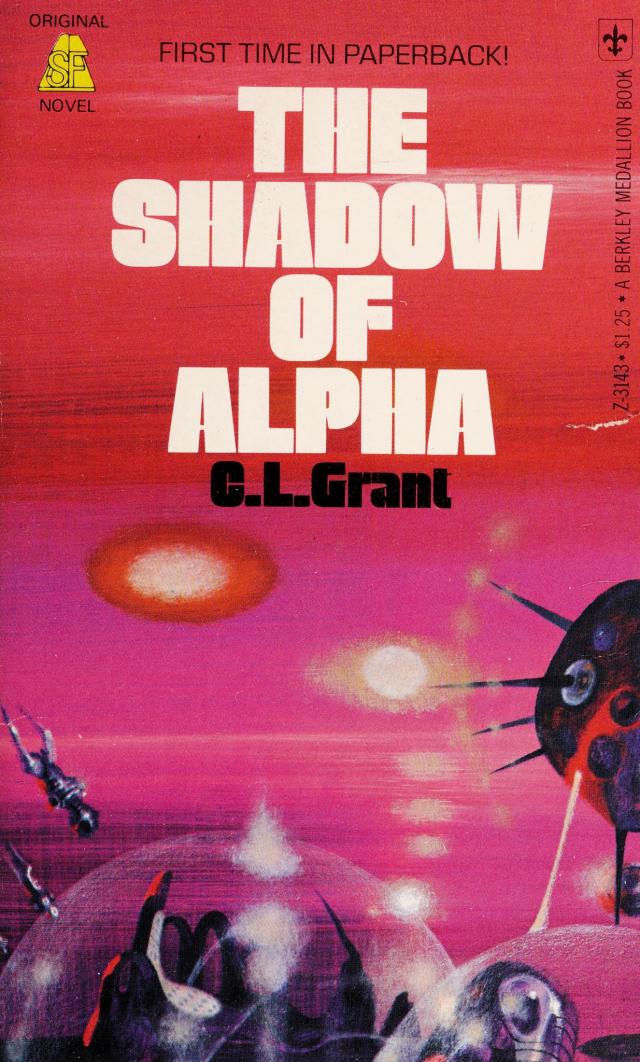
THE SHADOW
OF ALPHA
Chapter One
On a summer warm morning, Panic stood on the narrow, functionally ornamented porch of his three-room home and wondered what would happen to the universe should he decide to skip a day at the clinic and stay in bed, the better to count the holes in his head he must have had when he accepted this job in the first place. Grinning sardonically to himself, he composed a scenario of the cataclysmic consequences his non attention to the salvation of the human race would produce: the World of Finance would no doubt totter, teeter, and eventually unimpressively implode, throwing millions out of work, nations into war, and computers into red-blinking hysteria. Not to mention, he reminded himself, a World of Politics that would rumble, grumble, and swing into convulsive inaction behind the stumbling vanguard of a thousand newly formed investigatory committees. Science would shudder into classic test-tube breakdowns, Philosophy would begin muttering to itself in tongues not even the thinkers would understand, and the Arts would write itself a twelve-act, highly symbolic trivid operatic drama that would cast him as a sensuously sinister combination of Mephistopheles and the Whore of Babylon.
"!I think," he said to the shadows drawing from him, “I need a vacation.”
He sat, then, on the topmost of the porch’s four steps to await patiently the jagged saw of sanctioned lightning that would surely strike him to a cinder for his heresy; he waited long enough to realize that he was still quite alone.
“Fat chance I’d get hit anyway,” he decided, speaking with weary bitterness to the curves of his knees. “With my luck, I’d only get singed bald.”
He leaned back on his elbows, heedless of the dust gathering to his dark, loose-fitting shirt, and squinted a brief surveillance through the bright light. The Town, nameless, was silent when most towns in most sectors were blaring their way past sunrise into another, sometime productive, working day; and unlike most other communities, Parric’s Town was clean, shaded, neatly appointed with half-remembered greenery and sterile but well-meaning attempts at color-life gardens. The entire project had been conceived, plotted, and programmed in less than two decades, and his own portion was then constructed between foothills that formerly permitted only a stream to split them. That stream yielded now to the main street, and most of the low, broad-leaved trees had been summarily replaced by six blocks of single-story buildings blastpainted and prettified to maintain illusions of a community alive.
In a city that Parric preferred to forget existed, the Town was a number that printed out in four digits, followed by a series of relentlessly stubborn graphs which, according to those who read them, proved conclusively that man was finally ready to embark upon the solemn millennium of a nearly embalmed utopia.
But away from the magnetic tapes and weekly pep talks, Parric recognized the Town for what it was, no matter how often he was admonished by his employers to forgo his cynical responses to their evaluation questionnaires.
Façade.
Nothing more.
Behind every house, three to a block, was a yard, and' behind every yard was a shimmering tri-sectioned barrier that one could see only if the light was right and the angle just so. Nothing but air passed through in either direction, and beyond were the hills that wrenched their way through the seasons as if the Town hadn’t been there at all.
The main street, the side streets: to follow them the few short meters from the ends of the Town, and they stopped. Dead. Without even the dignity of fading into a trail.
“Ah, well,” said Parric as he had each morning for nearly a year, and he. rose, grabbed the briefcase he had toted from the kitchen, and began his walk to work.
The sun was a white-yellow bright, and a breeze hushed around him; above him in the fat-boled trees crowned a gleaming green. On the sidewalk were evidences of a night’s light rainfall occasioned by Climat-Con: angular puddles suspending shards of bark, blades of mown grass and twisted weak twigs that could not hang on long enough to be trimmed by Maintenance. The neighborhood, for the most part, was silent, but now and then he could hear the muffled cries of women summoning children, sprightly music to those who might have overslept. He saw Dan Bonetto bending awkwardly over a patch of garden by the side of his house, and he made a note. Willard Dix waved halfheartedly from his front yard, and Parric nodded. Two children scampered from behind a low hedge into the trafficless street, calling to him, and Parric answered with a grin.
Waking, the Town prepared to play a charade.
Façade.
But more often than not, Parric realized, what he had now was infinitely better, or so he liked to believe, than what had been just a year ago, and he used the time he spent walking to the clinic to remind himself of it as forcefully as he could.
He was sitting at his cubiclelike desk watching the rolling, interhouse comunit flash actuarial statistics when a Secretary, silver-rimmed black and as officious as a machine could get, slid into the huge office and blinked over the heads of the two dozen other clerks who were hunched over their occupations in mirror mime of Parric ’s own attitude. He paid little attention to the quietly humming robot, anticipating nothing as others usually did when it hove into their sanctuary. If not exactly inspired, Parric was nevertheless conscientious, and Everlasting Life Assurance, an innocuously steady non eminence in the field, had never had a complaint since he had joined the firm directly out of the training school it had paid him to attend. It was, then, a more than unsettling moment when the Secretary rolled silently to his desk and waited until he looked up.
“Franklin Parric?” The voice, recorded and resimulated to sound like a pleasant woman dying for a place to spend the night, instantly reminded him of the sirens who hummed sailors to death on a continent he had only seen in an atlas.
He nodded an affirmative and pushed away from his work, punching the screen on “hold” until, or if, the machine would leave him with his employment intact.
"There is a request that you take the first available opportunity from your duties, Mr. Parric, and report to Mr. Coates in Personnel. There will be no need for you to summon a replacement. Your position will be filled from the pool. ”
The Secretary took his stuttering to be a dismissal and glided out as swiftly as it had arrived.
At the Town’s only major intersection, four roads that led nowhere but preserved the ghostly ties with the outside world, Parric noticed his hands were perspiring as they had that day he had been mustered out of his office-to-home life. He remembered thinking in frantic circles about losing his apartment, his books, his food, his clothing, his unenthusiastic taste for life, and suddenly recalled how he had begun insanely calculating the height of the nearest walkway bridge.
You poor sap, he thought as he crossed the street, laughing aloud and startling himself with the explosion of noise in the silence. What was it they used to say: Had I but known?
Floyd Coates was short, flirting with jowls and trussed into a tunicsuit that might have made him appear slimmer had he had the proper tailor. Coates, however, was also parsimonious about the way he applied his finances to his appearance and thus looked as if he had taken a razor to a bedsheet. His eyes always appeared rabbit-wide frightened, never narrowing even in a frown, which now multiplied his facial folds „ as Parric stepped through the door that slid aside for him at his knock.
“Frankie," in a voice that grated like nails gently tracing over metal, “sit down, son, and light yourself something if you smoke. "
Parric sat gingerly on the edge of an old-style static chair, but only smiled his ref
“Frankie, you've been with us for nearly a dozen years now, and a fine round twelve that's been, too.
"Thank you, Mr. Coates.''
“We've never had words, that I can remember, and you've always been willing to put in a little overtime here and there to help Everlasting out. "
Parric thought of the bills that waited in ambush whenever he returned to his room-and-a-half castle, and shrugged deprecatingly. As the man continued the examination of whatever the console was showing him, Parric was reminded of a bear that couldn't wait for spring before replenishing fat lost during hibernation; his hands pressed hard against his knees, but he couldn't stop his shoulders from trembling.
“Well, Frankie, in grateful thanks for all you've done for us, I'm going to give you the opportunity to get loose from us."
“Loose?" Parric straightened, his obsequious servant pose shattering at his feet. * ‘ What does that mean ? You're firing me? Demotion? What?"
“Wait a minute, Franklin," Coates said, waving a thick-fingered hand to protect himself from Parric's sudden anger. “We are not going to fire you. There’s no cause. No cause at all. What we will do, however, is, well. . . I’m not really sure how to phrase it because the situation is, to say the least, unusual. But . . . let’s start with loan and see what happens."
"No offense, Mr. Coates," Parric said, "but you’re not making very much sense. You’re going to loan me, or give me a loan? Loan me? To Whom? For what?’’
The clinic was the only nonresidence in the Town, a square brown-and-white box with hinged windows and a door that hissed to one side when the welcome mat was trod upon. At the angle where lawn and sidewalk met was a plain white post from which an arm extended, dangling a rectangular black sign proclaiming the Clinic office of Franklin Y. Parric, MD. Parric flicked out a finger as he passed, watched the shingle swing gently before hurrying up the walk to insert the key that activated the entrance.
The waiting room was blandly furnished, could have been bare, and he stayed only long enough to thumb open the windows to air out the panel-enclosed space. If, he thought, he had received anything at all from his new life, it was the desire for continuing fresh air, air that arrived unbottled and reasonably untampered with direct from the atmosphere to the consumer. There were times, quiet hours during the early evening when he felt the loneliness the most, when he did nothing else but walk the streets breathing unfettered, so unique was the experience, so exhilarating the sensations.
And the back of the building was his workshop.
"Frankie, it will come as no surprise to you, working with the figures in your department as you do, that the world*s death rate has been climbing alarmingly over the past generation; a rate which, if continued, will not do us a heck of a lot of good in the foreseeable future. Needless to say, a lot of economies, including our own, could be in for a big crunch. Those PopCon folks sure did a hell of a job, didn’t they?”
“Excuse me, Mr. Coates, but I’ll have to disagree with you there. PopCon isn ’t entirely to blame. They only accelerated what probably would have happened anyway."
“I know, Frankie, I know and stand corrected. Bear with me then, and jump in whenever I stray again. If your reports are correct, and I’m sure they are, figures indicate that by the time populations had stabilized to an uncomfortable but tolerably high level, there were too many other factors that most people didn’t plan on, or just plain ignored in the hopes that they’d somehow vanish. Pollution in industrial centers rippled certain biological effects such as the increase in incidence of certain new strains of cancers we were unable to control quickly enough, much less identify in the beginning; refusal of places like India and the Central African Union to pay adequate attention to farm improvement implementation, which resulted in massive overloads and eventual soil nutrition depletion that progressed too rapidly for synthetics to match; the, uh, the .. . how many wars were there?”
“Six, ” Parric said, thinking of the last, from which he had been spared because of age when the Continental Draft was reinstated.
“Six,” Coates repeated, turning from the screen and staring at him. "Son, you’ve been telling us for years that something ought to be done or we might not be around long enough to find out how the Starship fared."
“The Alpha,” Parric said', believing the dignity of the momentous project was sullied without its proper name. ‘ Til tell you, I wish I had been smart enough to try out for it. You know, Mr. Coates, I'm not an active person, far from it, but there must be some way we can make the government, any government for that matter, see what we're heading for. Promises are fine when some joker’s running for office, but don’t you think there's something our industry can do to make them see beyond that?"
Coates smiled and handed him a cigar.
Parric dropped his briefcase into a corner and lifted a white smock from the back of a static chair he seldom used. His desk, utilitarian and small, was uncluttered, the bottom two drawers of a curiously outdated filing cabinet empty. The walls were undecorated and could have been blue except for the green one saw when not looking directly at them. It was comfortable, however, and Parric didn’t mind having an office all to himself after so many years of staring at the backs and heads of men he had never taken the time to meet. Checking his watch against the desk chronometer, he nodded and shuffled a handful of folders from the cabinet before opening the closet and huffing out a diagnostic unit nearly two meters high and half again as wide. After activation and a quick review/check, it settled its cylindrical bulk and waited, as Parric did, for the first patient.
“You know something,” he said to the unit as he stared out the rear window at the forest that rose higher than he could see without bending, "I think I’m getting a headache. Maybe I should take the day off and try some fishing. Assuming, of course, that there are still fish out there somewhere.”
A chime whisper-smooth interrupted his rebellion in thought, and he turned around to greet Mrs. Keller.
There had been thirty-five men besides himself chosen at random for their low profiles: average ambition, drive, and intelligence, reliable loyalty potential, and the fact that none had had the commitment urge to make more than token attachments to the world at large. They were flown to Sector Capital Washington, mildly protesting but more attentively intrigued, where they were checked and checked again for possible security breaches, though none had ever been in a position to do more than simply survive. Handsome salaries and promises of future security damped their uneasiness while they were bottle-fed information about the Towns and their inhabitants.
And were told: as populations dropped slowly toward the levels of the end of the first industrial age, man discovered that the so-called good life and its trinkets were not all that was dreamt of in poetry and prose. With more for everyone, there was, increasingly, less of everyone to enjoy it.
Factor number one, it was stressed, was the need to create a larger consumer base, or industry would falter, people would lose their time-consuming jobs, and there would be starvation and apathy in the midst of plenty.
Factor number two, which Parric more readily understood that the economics, was the emergence of a psychological dependency on neighbors. Ironically, the overcrowding of earlier centuries had developed within many the need for people close by. At the same time, several countries began to see the tempting availability of more and more land for their citizens; and from the year 2004, six wars of varying sizes, intense in their medieval dedication to the absorption of borders, caused the largest nations to realize that manpower was becoming too valuable to waste.