The anthrax mutation v1.., p.1
The Anthrax Mutation (v1.0), page 1


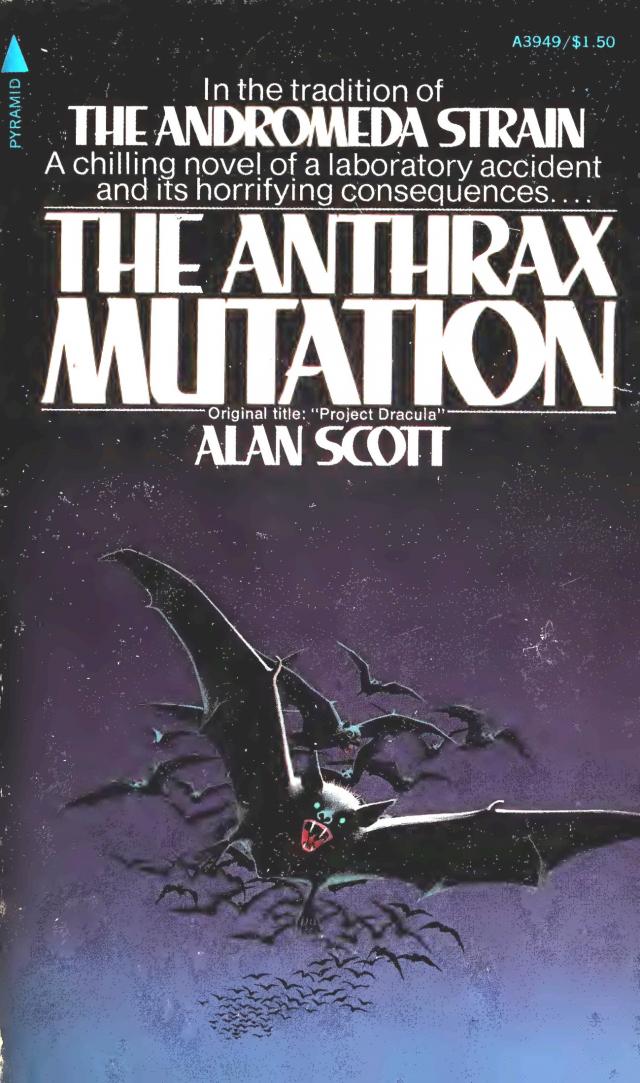
PANDIMIC!
• McRoberts stumbled over grotesquely disfigured bodies, clutching his mask. He had to reach a telephone. Suddenly McTavish was there, his face encrusted with black pustules, clutching at McRoberts mask, exposing him to the deadly anthrax spores…
• Trevor, aged 12, was late getting home to Strumford. He pedaled quickly towards the darkened village, aware that something was amiss, but never suspecting that his parents and friends, all his neighbors, were dead…
• The family stepped off the boat onto another shore. They were safe at last. But the angry crowd greeted them with hysterical shouts, showering them with bullets. How dare they come here, carrying their dread disease…
MAN’S ERROR HAD DISPERSED THE DEADLY ANTHRAX SPORES ACROSS THE COUNTRY. SOON THEY WOULD SPREAD THROUGHOUT THE WORLD. THIS IS THE HORRIFYING STORY OF WHAT HAPPENS WHEN AN EXPERIMENT IN BIOLOGICAL WARFARE BACKFIRES, CLAIMING ITS CREATORS AS VICTIMS…
The
Anthrax
Mutation
(Original title: Project Dracula)
ALAN SCOTT
THE ANTHRAX MUTATION
(Original title: Project Dracula)
A PYRAMID BOOK Copyright © Alan Scott 1971
All rights reserved. No part of this publication may be reproduced or transmitted in any form or by any means, electronic or mechanical, including photocopy, recording, or any information storage and retrieval system, without permission in writing from the publisher.
Pyramid edition published April 1976
ISBN 0-515-03949-7
Printed in the United States of America
Pyramid Books are published by Pyramid Publications
(Harcourt Brace Jovanovich). Its trademarks, consisting of the
“Pyramid” and the portrayal of a pyramid, are registered in the
United States Patent Office.
Pyramid Publications
(Harcourt Brace Jovanovich)
757 Third Avenue, New York, N.Y. 10017
Contents: -
ACKNOWLEDGEMENTS
PROLOGUE
SECTION ONE: THE INVASION
Saturday, 10th October I
Stumford. 19:15 Hours
Chesterly: 19:30
SECTION TWO: DETECTION AND THE OFFENSIVE Sunday, 11th October II
Chesterly. 10:45 Hours
Stumford. 14:30 Hours
Beckington. 17:30 Hours
London. 19:45 Hours
London Heathrow Airport. 12:50 Hours
Whitehall. 1:30 Hours
Stumford. 1:50 Hours
Whitehall. 14:56 Hours
Whitehall. 08:10 Hours
Belfast Avenue, Slough, Bucks. 09:00 Hours
Whitehall. 09:00 Hours
Monday. 10:00 Hours
Salisbury Plain, 10:15 Hours
Whitehall. 10:30 Hours
Southampton Waters. 11:00 Hours
The Perimeter. 12:00 Hours
Coastal Waters. 14:30 Hours
Whitehall. 16:00 Hours
Perimeter. 16:45 Hours
Whitehall. 17:00 Hours
Point of No Return. 17:15 Hours GMT
Hillingdon, Middlesex. 17:45 Hours
Whitehall. 18:55 Hours
The Vicarage. Stoke Poges. 19:20 Hours
Regent Park. London. 20:00 Hours
Newsroom. Television Center. London. 21:00 Hours
The Vicarage. Stoke Poges. 21:20 Hours
SECTION THREE: ATTACK Tuesday, 13th October III Perimeter Track. 11:00 Hours
Wolverhampton. 11:30 Hours
Ashley Grove School for Boys. Epping, Surrey 11:45 Hours
Ruislip. 12:00 Hours
Whitehall. 12:30 Hours
The People
Ruislip. 13:15 Hours
Wolverhampton. 15:15 Hours
Ruislip. 15:40 Hours
SECTION FOUR: OUTCOME Tuesday, 13th October IV Ruislip. 18:15 Hours
Woverhampton. 18:30 Hours
Ruislip. 18:52 Hours
EPILOGUE
are you
missing out on
some great
Pyramid books?
ACKNOWLEDGEMENTS
I would firstly like to express my thanks to Elizabeth Compton who has pioneered the fight against chemical and biological weapon research in this country. Her advice and criticism have guided me along the uncomfortable study of gas and germ warfare. I must also express my gratitude to many people who have contributed in their own personal way towards making The Anthrax Mutation the book it is. I especially wish to acknowledge the patience and assistance of my students, Nigel and John, who have endured more my typing than my teaching, and to Thomas Anderson for his invaluable technical assistance.
This book is in no way directed at one specific person or enterprise, and where specific names of companies or people have been used, this in no way implies that they would become involved in any eventuality as described in this story. Unless specifically mentioned, any similarity to persons living or dead, or to any company, is unintentional.
I have relied upon several sources of information in the writing of this book and I name a few of them as references for any reader who may wish to explore further the realms and implications of chemical and biological research. Under this heading and those of specific chemical and biological agents the “Encyclopaedia Britannica” offers concise explanations. “Chemical and Biological Warfare, America’s Hidden Arsenal” by Seymour M. Hersh (MacGibbon and Key, 1968) offers a broader understanding of American and international involvement in such research while “We All Fall Down” by Robin Clarke (Pelican, 1969) traces the history and current development of gas and germ warfare and includes informative tables in its Appendix. Government information services, the Ministry of Defense and the individual military services will release no pertinent information to any private person.
PROLOGUE
The Fort Detrick Research Station is perhaps the largest in the world. Its sole purpose is to provide a testing and developing center for biological weapons which could be used in an attack against hostile countries or in the defense of the United States. The station-produces many of the mutated forms of biological agents and is continually creating improved viruses, bacteria and other micro-organic substances. As early as during World War II, Detrick developed a way of concentrating twenty-four thousand, nine hundred billion Brucella organisms into an ounce of ordinary paste. Its current research involves the development of organisms which cause tularemia, Rocky Mountain Spotted Fever, Q-Fever, encephalomyelitis, brucellosis, plague and anthrax. Detrick is also concerned with the various methods in which these substances can be disseminated for maximum effect.
Because the American government feels that research in these areas is vital to the defense of the country, we have the greatest facilities found anywhere in the world for cultivation and investigation of biological weapons. However, we still enjoy a close liaison with our allies in developing these arsenals; for our mistakes and the mistakes of our allies contribute towards international experimentation which increases the defense of the free world; since mutual exchanges of information save both money and thousands of man hours of intensive research. England in particular is very much involved in this interchange of information. The research base at Porton in Wiltshire is to Great Britain what Detrick is to America. But many times our mutual discoveries are kept secret for months, sometimes for ever. Naturally, neither the United States nor Great Britain wish to let each other know exactly who’s got what or what each is currently developing. It has happened that a country will take up a project which America gave up as unsatisfactory and carry it further or develop it to suit its particular needs. This is what England was doing, but keeping it a closely guarded secret, so secret in fact tl^at only the Dwarf Hill Microbiological Establishment in Cornwall knew the full details. But somewhere along the ultra-security block something slipped and Detrick got wind of it. Because my job was Liaison Officer among the international weapons research centers, I was sent from Fort Detrick to try to uncover what mysterious project the English had dug up from the grave of American rejects. We had no real information other that the scheme dealt with a time-delay delivery of highly potent anthrax bacillus. My colleagues who joined me on the expedition had no idea of which plant was working on the project, nor had I. We were invited to tour each of the bases on the precept that it was the periodic comparison-of-notes visit that we make and reciprocate. None of us had any real idea of what to look for and most probably anything we did discover would be by chance. We had done this sort of thing many times before, though, and we knew the ways of getting around security precautions and reticent military officials. One of us might come up with the answer in his individual inspection and we would all return home, having thanked the British government profusely for a charming and enlightening visit, and having expressed the hope that we could soon see some of their men visiting us. It was all very formal, cordial and downright phoney.
Exactly what did happen after we landed in England and how the discovery of what the British were up to was made is chronicled here. It is ironic that we came to England to discover what secrets they kept, and in the end we had to surrender one of our most tightly guarded biological defense weapons in order to save England from herself.
SECTION ONE: THE INVASION
Saturday, 10th October
I
The Captain was impatient. He paced the white tiled corridor, glared at his watch, turned on his heels, and stomped b
“Nothing yet, Sir. Who is it this time?”
“Bloody Yanks, that’s who. You’d think they know enough without having to come snooping around here.”
“Yes, Sir,” the Private acknowledged meekly. A bell rang. The Private looked up from the switchboard. “It’s them, sir.”
The Captain strode off in the direction of the main entrance, mumbling anti-Americanisms. Last week it had been anti-Germanisms (Hadn’t they done enough in the last War?) and the week before that he had been ordered to bone up on his French so as to converse more easily with a contingent of—in his words—Frogs. Bloody annoying, he was thinking. Won’t let us get on with things. He knew of a thousand reasons not to let foreigners come traipsing around the plant, security being one of his priorities, and England another.
“Look sharp, Corporal,” he snapped bad naturedly at a wooden crate on two legs. “And what in hell is that full of?”
“Bats, Sir,” replied something from behind, below or beneath. “For Section Three.”
“Bats?”
“Yes, Sir. And they’re rather heavy, Sir.”
“Get on with it then. And mind none of them have any teeth.”
The Corporal turned slightly. “Teeth, Sir?”
“Bats—you know. Blood and vampires.”
The Corporal stared at the crate which nestled uncomfortably close to his neck. He stretched his arms out and scurried around the corner towards Section Three.
The Captain grinned. “Bats. What next?” He reached the main entrance in time to see a car pull up. As he had done so many times before, he quick-stepped up to the door and swung it open. “Captain Andrew McRoberts, Sir,” he saluted crisply.
Colonel Wyers returned the salute from his seat. “Captain, this is Major Glen Thomas from the Fort Detrick group. Major Thomas, meet my unofficial first mate. Captain McRoberts will take you over the base.” As he heaved himself from the car, he turned to the Captain and nodded imperceptibly. “I won’t delay you. Meet you in the mess in an hour.”
Major Thomas swung across the seat and stepped out. He wanted to stretch, but he reserved the pleasure for another time. Instead, he glanced about him and watched the car roar away much like a child on his first day at boarding school. “How do you do, Captain,” he smiled at length. “I suppose I’m wearing out the visitors’ mat.”
The Captain glanced up. “How’s that, Sir?”
“I understand you’ve been having sort of a mini UN going on up here.”
“It’s not been easy, Sir,” he admitted as they walked up the steps and passed through the glass doors into the spotless corridor. “These lads find visitors disturbing.” “And you?” Thomas said casually.
“It’s security, Major. And it’s the work. Damned funny business, all this. Top secret, hush-hush. Why the lads feel they’re fenced in—even in the town. Then you lot come marching about the place—well I’m sure your boys have the same problems.” He stopped at the Security
Desk and pushed across a folded card. The guard glanced at the pass, looked up at the Major, and pushed a button on the panel in front of him. Major Thomas heard a slight hiss and another set of glass doors opened automatically.
“We’re a bit tighter than you,” Thomas began, noticing a sign which was directing them towards Section Two. “No one but the very special.”
“Smart fellows. Wish we could be as strict.” The Captain pushed open a door ominously labelled “Danger, Neuro-Cerebral Toxicants” and nodded at a group of men in white coats and plastic gloves. “This is Section Two. We process much of the nerve gases here before sending them on for mass production—stockpiling. Sort of the final filter.”
Major Thomas stared over the shoulders of the researchers who were totally absorbed in their labors—a maze of test tubes, burners and glass pipes. “Do you develop the gas or just refine?”
“A little of both,” someone offered without glancing up.
Their attention was focused on a large glass bulb which was turning a crimson, fading, and trying a different color. The explanation continued. “The raw gases come to us for separation into the toxic agents. Sarin, GB, VX and all that. We process only in very small amounts. Porton handles all the big stuff.”
There were some guinea pigs and rabbits munching lettuce in their cages. Major Thomas sidled over and tapped one of the glass panes. The guinea pig wasn’t interested. “How many of these do you. get through?”
One of the scientists looked up. “Quite a few. We have to test each new batch before sending it on.” He grinned. “Shouldn’t want anyone killed with bad gas.” “Very humorous,” his colleague snapped, leaving the table on which the bulb continued its exploration of the color spectrum. “We test new batches because we don’t want any unknown effects creeping in—effects we don’t already know about. Here,” he said, lifting a rabbit from its cage. “We’re going to put some of that gas in the bulb through its paces. It seems a bit unstable at the moment.”
The Major followed the scientist over to the table on which sat the rabbit apparently unconcerned about his questionable future as he ruminated on the remains of his lettuce.
“We use a two cc solution of about the same proportion as one might expect to find in the field. The VX gas is rather effective in that it throws the nervous system into chaos—but I’m sure you’re well up on all this.”
The Major raised his eyebrows uncommittingly. He watched the rabbit’s courier of death plunge the hypodermic into its side.
“Almost immediately you will notice the body begin to convulse. Next paralysis sets in until the rabbit can no longer breathe. We’ve found that in most cases there is a general constriction of the organs and muscles including the erection of the male reproductive organ and a secretion from the tear and salivary glands. Though heart rate is considerably retarded, death comes from paralysis of the lungs—sort of a cross between drowning and suffocation.”
The Captain was still staring at the rabbits and guinea pigs who nestled safely in their cages. He had seen it all too often to be even callously interested. But Major Thomas watched carefully as the rabbit struggled to fill his paralysed lungs and at the same time choked to death on his own saliva.
“We find that GB has much the same effect,” Thomas began. “Though its persistence is far less than VX. We prefer inhalation or ingestion rather than injection.”
“Yes, I’ve read your papers on that. About some chaps who wandered into the testing area or something…
Thomas heard this one before. “And Martin and Cockayne? Didn’t they work here?”
The researcher grinned without taking his eyes from the dead rabbit. “Accidents have’ been known to happen, I daresay. This sort of thing can get pretty sticky—especially if the public get on to it.”
“I can’t recall any of our men here meeting up with any accidents,” mumbled the Captain as he pushed away from the cages. “And I’ve been here since we opened.”
It was an obvious effort. The researcher looked up at Thomas and smiled knowingly. “No, not a single case. Must have been somewhere else. We have all the safety devices, you know. We hold a very respectable record.” “And you don’t stockpile any of this stuff?” the Major asked.
“In very small quantities,” the Captain replied. “We’ve got more than usual here this week as we’ve only just completed testing several batches, but most of it will be shipped out tomorrow. Porton carries the stocks, but you must realize that each of our plants works independently of one another. Very little information passes between us unless it’s of vital importance. The Ministry feels it’s better that way—security and all. Really, we hardly know anything of what the other plants are developing—all that’s left up to London.” He led him out of Section Two and passed through another set of automatic doors into Section Three. There was a sentry sitting before the large metal gates which barred the way into the inner laboratory. He rose as the Captain approached.