The web she weaves, p.1
The Web She Weaves, page 1


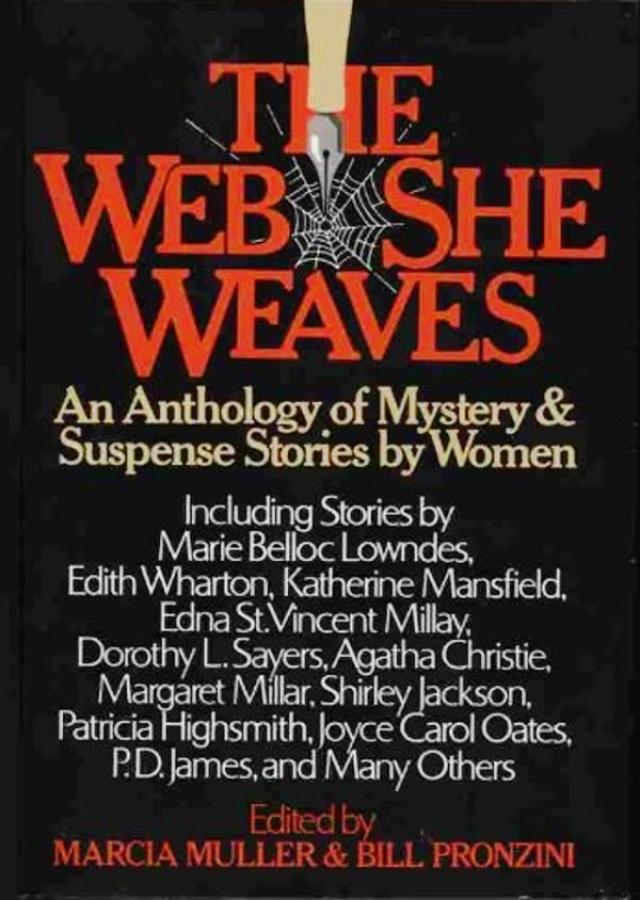
THE WEB
SHE WEAVES
THE WEB
SHE WEAVES
An Anthology of Mystery
and Suspense Stories by Women
Edited by
MARCIA MULLER & BILL PRONZINI
William Morrow and Company, Inc.
New York 1983
All rights reserved. No part of this book may be reproduced or utilized in any form or by any means, electronic or mechanical, including photocopying, recording or by any information storage and retrieval system, without permission in writing from the Publisher. Inquiries should be addressed to William Morrow and Company, Inc., 105 Madison Avenue, New York, N.Y. 10016.
Library of Congress Cataloging in Publication Data Main entry under title:
The Web she weaves.
1. Detective and mystery stories, American—Women authors. 2. Detective and mystery stories, English—
Women authors. I. Muller, Marcia. II. Pronzini, Bill,
PS648.D4W4 1983 813’.0872‘089287 83-8288
ISBN 0-688-02453-x
Printed in the United States of America
First Edition
1 2 3 4 5 6 7 8 9 10
BOOK DESIGN BY SALLIE BALDWIN
Grateful acknowledgment is extended to the following for permission to reprint:
“Postiche,” by Mignon Eberhart. Copyright © 1935 by The Butterick Company; copyright renewed © 1962 by Mignon G. Eberhart. Reprinted by permission of Brandt & Brandt Literary Agents, Inc.
“Suspicion,” by Dorothy L. Sayers. From In the Teeth of the Evidence. Copyright © 1940 by Dorothy L. Sayers. Reprinted by permission of A. Watkins, Inc.
“Harlequin’s Lane,” by Agatha Christie. Copyright © 1930 by Dodd, Mead and Company; renewed © 1957 by Agatha Christie Mallowan. Reprinted by permission of Harold Ober Associates, Inc.
“His Heart Could Break,” by Craig Rice. Copyright © 1943 by The American Mercury, Inc. Reprinted by permission of Scott Meredith Literary Agency, Inc., 845 Third Avenue, New York, N.Y. 10022, agents for the estate of Craig Rice.
“Chinoiserie,” by Helen McCloy. Copyright © 1946 by Helen McCloy; renewed © 1977 by Helen McCloy. Reprinted by permission of the author.
“Good-bye, Miss Lizzie Borden,” by Lillian de la Torre. Copyright © 1947 by Lillian de la Torre; renewed © 1974 by Lillian de la Torre McCue. Reprinted by permission of Harold Ober Associates, Inc.
“McGowney’s Miracle,” by Margaret Millar. Copyright © 1954 by Hearst International, Inc.; renewed © 1982 by Margaret Millar. Reprinted by permission of Harold Ober Associates, Inc.
“St. Patrick’s Day in the Morning,” by Charlotte Armstrong. Copyright © 1959 by Davis Publications, Inc. First published in Ellery Queen’s Mystery Magazine. Reprinted by permission of Brandt & Brandt Literary Agents, Inc.
“The Possibility of Evil,” by Shirley Jackson. Copyright © 1965 by Stanley Edgar Hyman. First published in The Saturday Evening Post. Reprinted by permission of Brandt & Brandt Literary Agents, Inc.
“The Snail-Watcher,” by Patricia Highsmith. Copyright © 1964 by Patricia Highsmith. First published in Gamma Magazine. Reprinted by permission of the author and her agent, Diogenes Verlag AG, Zurich, Switzerland.
“The Locked Room,” by Celia Fremlin. Copyright © 1968 by Celia Fremlin. First published in Ellery Queen’s Mystery Magazine as “From the Locked Room Upstairs.” Reprinted by permission of the author.
“The Fall of a Coin,” by Ruth Rendell. Copyright © 1975 by Ruth Rendell. First published in Ellery Queen’s Mystery Magazine. Reprinted by permission of the author and Georges Borchardt, Inc.
“Double Jeopardy,” by Susan Dunlap. Copyright © 1978 by Susan Dunlap. First published in Ellery Queen’s Mystery Magazine as “Death Threat.” Reprinted by permission of the author.
“My Neighbor, Ay,” by Joyce Harrington. Copyright © 1974 by Joyce Harrington. First published in Ellery Queen’s Mystery Magazine. Reprinted by permission of the author.
“Norman and the Killer,” by Joyce Carol Oates. Copyright © 1965, 1966 by Joyce Carol Oates. Reprinted by permission of the author.
“Cattails,” by Marcia Muller. Copyright © 1983 by Marcia Muller. An original story published by permission of the author.
“Great-Aunt Allie’s Flypapers,” by P. D. James. Copyright © 1978 by Faber and Faber, Ltd. First published in Verdict of 13. Reprinted by permission of the author and her agents, International Creative Management, Inc.
Contents
INTRODUCTION
THE LODGER - Marie Belloc Lowndes
THE DUCHESS AT PRAYER - Edith Wharton
THE MAN IN THE INVERNESS CAPE - Baroness Orczy
THE WOMAN IN THE STORE - Katherine Mansfield
MURDER IN THE FISHING CAT - Edna St. Vincent Millay
THE LIPSTICK - Mary Roberts Rinehart
POSTICHE - Mignon G. Eberhart
SUSPICION - Dorothy L. Sayers
HARLEQUINS LANE - Agatha Christie
HIS HEART COULD BREAK - Craig Rice
CHINOISERIE - Helen McCloy
GOOD-BYE MISS LIZZIE BORDEN - Lillian de la Torre
McGOWNEY’S MIRACLE - Margaret Millar
ST PATRICK’S DAY IN THE MORNING - Charlotte Armstrong
THE POSSIBILITY OF EVIL - Shirley Jackson
THE SNAIL-WATCHER - Patricia Highsmith
THE LOCKED ROOM - Celia Fremlin
THE FALL OF A COIN - Ruth Rendell
DOUBLE JEOPARDY - Susan Dunlap
MY NEIGHBOR, AY - Joyce Harrington
NORMAN AND THE KILLER - Joyce Carol Oates
CATTAILS
Marcia Muller
GREAT-AUNT ALLIES FLYPAPERS
P D. James
INTRODUCTION
With the exception of such legendary figures as Agatha Christie and Dorothy L. Sayers, mystery and suspense fiction is thought by the general readership to be largely the domain of men. In truth, however, it is difficult to find any supportable basis for the idea of the male writer as owner and sole shaper of the genre.
Witness the following evidence to the contrary:
As early as 1867—twenty years prior to the appearance of the first Sherlock Holmes story—Seely Regester (the pseudonym of Mrs. Metta Victoria Fuller Victor, 1831-1886) published the first American detective novel authored by a woman, The Dead Letter. Although tedious and full of such trappings as illegitimacy, robbery, clairvoyance, strange suitors, and a final assembly in the parlor, Miss Regester’s novel paved the way for more competent efforts on both sides of the Atlantic.
In 1878, American writer Anna Katharine Green’s (1846-1935) The Leavenworth Case became an overnight Success. Miss Green also gave us the first spinster sleuth, Amelia Butterworth, who began her unabashed snooping in The Affair Next Door (1897) and continued it in Lost Man’s Lane (1898). Younger but equally nosy was Miss Green’s Violet Strange, who appeared in The Golden Slipper (1915) and who was assisted by—the Watson of all Watsons—a bloodhound.
Another early female detective, Loveday Brooke, was the creation of Catherine Louisa Pirkis. In addition to The Experiences of Loveday Brooke, a collection of seven stories published in 1894, Mrs. Pirkis wrote thirteen other thrillers, many of them featuring amateur female sleuths.
In England, Lillie Thomas Meade (1854-1914), in collaboration with the pseudonymous Dr. Clifford Halifax, produced a series of medical mysteries about a country doctor for The Strand in 1894. For the same magazine four years later, the versatile Miss Meade then created, in collaboration with Robert Eustace, one of the first female master criminals, Madame Koluchy, who sent a gang of Italian thugs out to do her dirty work for her. Another of Miss Meade’s heroines, Madame Sara of The Sorceress of the Strand (1903), took matters into her own hands to become one of our most prolific of fictional female murderers.
The Hungarian-born Baroness Emmuska Orczy contributed one of the first and most important armchair detectives, The Old Man in the Corner, in 1901 (“the corner” being a booth in a London tearoom from which the old man seldom ventures). Another of her heroes, the eccentric Scarlet Pimpernel, outfoxed nearly everyone during the French Revolution; and Lady Molly Robertson-Kirk joined the ranks of professionals at Scotland Yard in 1910 as she sought to overturn her husband’s murder conviction.
An important contribution in the area of psychological suspense came in 1913, with the publication of Marie Belloc Lowndes’s The Lodger. Many of Mrs. Lowndes’s works are based on historical events, but in this one, which explores the Jack the Ripper murders, the outward happenings are not nearly so important as the tensions of the relationships between the characters involved. This, too, was an important innovation in the field.
Back in America, Mary Roberts Rinehart was busy establishing what has come to be called the “Had I But Known” school of suspense writing. Replete with fluttery and sometimes foolish heroines, Mrs. Rinehart’s novels and stories contain numerous confrontations with the dark forces of evil, during which the lady would be heard to murmur, “Had I but known then what I know now …” The author, a nurse herself, also gave us Miss Pinkerton, an early nurse-detective.
Carolyn Wells (1869-1942) began one of the longest-running detective series when she introduced private investigator Fleming Stone in The Clue (1909). Stone went on to solve a previously unprecedented total of sixty-one cases over the ensuing four decades. Miss Wells was more accomplished as a teacher than as a writer, however; her major offering to the genre is The Technique of the Mystery Story (1913), in which she sets forth rule
During the “Golden Age” of crime fiction (the period 1925 to 1940), women writers flourished. The most famous of these, of course, is Agatha Christie. Recipient of the first Mystery Writers of America Grand Master Award in 1954, Mrs. Christie gave us sixty-eight novels over her long career, beginning with The Mysterious Affair at Styles in 1920, as well as such celebrated sleuths as Hercule Poirot, Miss Jane Marple, Parker Pyne, the mysterious Harley Quin, and the husband-and-wife team of Tommy and Tuppence. Her play, The Mousetrap, which opened in 1952 and has yet to close, is the longest-running production on the British stage.
Other acclaimed and still popular British mystery novelists who began writing during the Golden Age include Dorothy L. Sayers, the creator of the aristocratic Lord Peter Wimsey and his “right-hand woman,” Miss Climpson, who star in such novels as Unnatural Death and Strong Poison, and such short story collections as Lord Peter Views the Body; New Zealander Ngaio Marsh, who brought us the sophisticated Roderick Alleyn in A Man Lay Dead in 1934; Daphne du Maurier, who was and still is a Gothic novelist with an unparalleled hand at atmospheric suspense, as seen in Rebecca (1938); Margery Allingham, who wrote both fast-moving, action-packed adventure stories and novels of deep psychological characterization; and Scotswoman Josephine Tey (Elizabeth Mackintosh), who gave us Miss Pym, an amateur sleuth in an academic setting, and the elegant Alan Grant of Scotland Yard, hero of the classic The Daughter of Time.
On this side of the Atlantic, Golden Age authors were fewer, but their contributions are equally significant. Two of the most notable are Mignon G. Eberhart, whose career began with the publication of The Patient in Room 18 in 1929, progressed through sixty additional novels of quality, and reached its high point in 1970 when she was presented with MWA’s Grand Master Award; and Helen McCloy, the creator of the first psychiatrist detective, Dr. Basil Willing, who made his first bow in Dance of Death (1938).
During World War II and in the years following, many other women established themselves as important mystery writers. The works of Canadian Margaret Millar, whose first novel, The Invisible Worm, appeared in 1942, have been widely acclaimed for their sensitive, psychologically oriented suspense and sharp character development. Charlotte Armstrong’s novels and short stories (The Unsuspected, A Dram of Poison) often explore the theme of peril to the very young and the very old with considerable deftness. The prolific Craig Rice, in such novels as The Sunday Pigeon Murders (1942) and Home Sweet Homicide (1944), gave us a kind of wacky humor that at that time was rare in the genre.
A number of Dorothy B. Hughes’s excellent novels (Ride the Pink Horse, The Candy Kid) offered vivid portraits of Mexico and her native Southwest during the postwar years, and she is an award-winning reviewer in the field as well, having received the 1950 Edgar for her critical acumen. Dorothy Salisbury Davis demonstrated her keen insight and sympathy for the underdog in such novels as A Gentle Murderer (1951). Lillian de la Torre, a true-crime expert and aficionado of the theater, created the award-winning series of historical detective stories in which Dr. Samuel Johnson appears as sleuth. American expatriate Patricia Highsmith began writing such chilling and memorable psychological suspense novels as Strangers on a Train. And Helen Maclnnes proved a woman could write first-rate spy novels by publishing more than fifteen, including The Double Image and The Snare of the Hunter.
Perhaps the best known of the present-day “women of mystery” is P. D. James, whose Chief Superintendent Adam Dalgliesh and private eye Cordelia Gray have delighted millions. Also notable among modern practitioners are Ruth Rendell, with her excellent police procedurals featuring Chief Inspector Wexford of Scotland Yard, as well as with such straight suspense novels as Master of the Moor (1982); the prolific Elizabeth Linington, who writes series under her own name (Sergeant Ivor Maddox) and the pseudonyms of Dell Shannon (police detective Luis Mendoza) and Lesley Egan (Jesse Falkenstein and Vic Varallo); the collaborative team of Mary J. Latis and Martha Hennissart, who, under their pen names of Emma Lathen and R. B. Dominic, have been hailed as mistresses of witty and charming detective stories; Maj Sowall, the Swedish poet who co-authored, with her late husband, Per Wahloo, a fine series of police procedurals set in Stockholm (The Laughing Policeman, The Terrorists); and Carolyn Weston, also a writer of procedurals, whose novels such as Poor, Poor Ophelia (1972) became the basis for the TV series The Streets of San Francisco.
In keeping with the expansion of occupational opportunity for women, other contemporary authors have begun placing their heroines in jobs they would not have held ten years ago. Lillian O’Donnell’s Norah Mulcahaney (The Phone Calls, Don’t Wear Your Wedding Ring) detects for New York’s finest, often taking on cases of special interest to women. Equally effective as a public crime-fighter is Dorothy Uhnak’s Christie Opara (The Bait, The Ledger); a former policewoman herself, Uhnak has also written a number of other novels, such as Law and Order, which draw on her police experience. Sue Grafton and Marcia Muller have created believable female private investigators, with their own unique personalities, that are anything but distaff imitations of Sam Spade and Philip Marlowe.
And finally, contributions to the genre have not been limited to those authors we generally think of as mystery writers. Louisa May Alcott, for example, put aside her genteel tales for young people long enough to produce several stories in the Gothic-suspense mode. Edith Wharton used her fine sense of characterization to build both psychological and supernatural suspense. Katherine Mansfield, Dorothy Parker, Edna St. Vincent Millay, Willa Cather, and Fannie Hurst, among others, dabbled in matters criminous with great success. One of the best known of modern literary writers, Joyce Carol Oates, has often worked in the mystery-Gothic mode, notably in her National Book Award-winning novel Them (1969); much of her fiction, in fact, contains marked suspense elements.
The volume of evidence presented above, it seems to us, makes the case for women as primary forces in the shaping of the mystery genre a conclusive one. If further evidence is needed, we offer the stories in the pages that follow. They span close to one hundred years of mystery and suspense writing, and exhibit a wide variety of subject matter, style, and approach. We’re quite sure you’ll find them every bit as entertaining and expert as any produced by their male counterparts during that same time frame.
The defense rests.
—Marcia Muller and Bill Pronzini
San Francisco, California
December 1982
THE LODGER
Marie Belloc Lowndes
Marie Belloc Lowndes (1868-1947) was born into a distinguished family, whose members included literary figures, barristers, and scientists. She claimed to have written every day of her life from the age of sixteen, and her finely crafted novels, plays, and short stories are evidence of the continual rewriting and polishing that her perfectionist nature demanded. Mrs. Belloc Lowndes is primarily known for her crime and suspense novels, which rely heavily on character development and the relationships between men and women. “The Lodger,” which the author later expanded into a novel of the same title, is a tale of psychological suspense based on the Jack the Ripper murders. The story has so fascinated filmmakers that four versions have been produced, beginning with Alfred Hitchcock’s 1926 adaptation.
“ There he is at last, and I’m glad of it, Ellen. Tain’t a night you would wish a dog to be out in.”
Mr. Bunting’s voice was full of unmistakable relief. He was close to the fire, sitting back in a deep leather armchair —a clean-shaven, dapper man, still in outward appearance what he had been so long, and now no longer was—a self-respecting butler.